Staggered wheels means wider wheels and tires on the rear than the front. Learn why cars use them, what they cost you in rotation and tire life, and how to buy tires for a staggered setup.
Staggered wheels means the rear wheels and tires are wider than the fronts. A typical setup is 8.5-inch-wide wheels with 245 mm tires in front and 9.5-inch wheels with 275 mm tires in the rear. Rear-wheel-drive performance cars use it for traction and balance. The cost is that you cannot rotate the tires front to rear, so they wear unevenly and get replaced in pairs. Here is how staggered setups work, what they do to tire life, and how to buy tires for one.
This guide is part of our complete guide to buying tires online.
In this guide
- What staggered wheels mean
- Why cars use a staggered setup
- Square vs. staggered: the difference
- Pros of staggered wheels
- Cons of staggered wheels
- Can you rotate staggered tires?
- Buying tires for a staggered setup
- Should you switch to staggered or square?
- Frequently asked questions
What staggered wheels mean
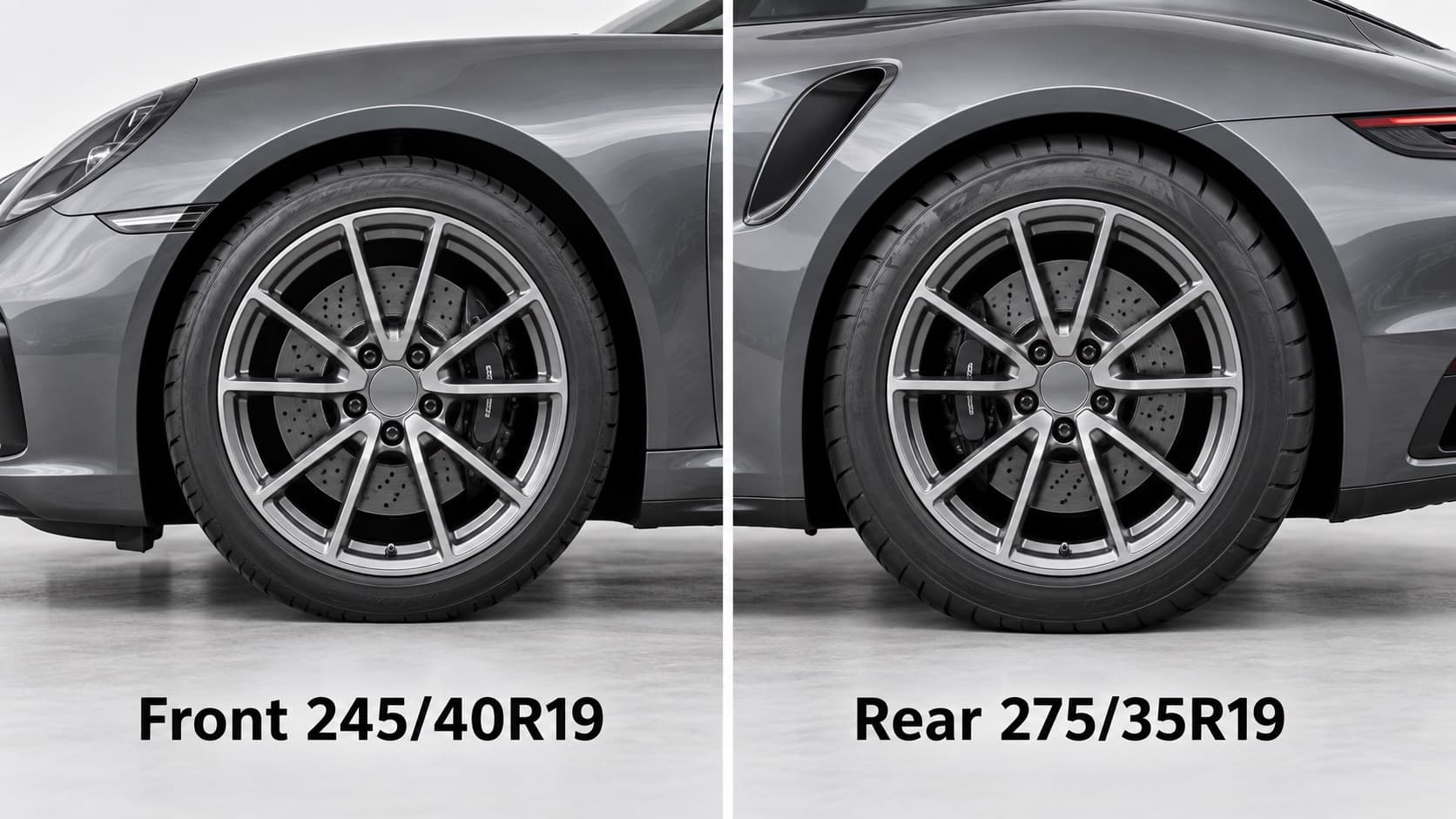
A staggered setup, also called staggered fitment, uses two different wheel and tire sizes on the same car: narrower in front, wider in the rear. The wheel diameter is usually the same front and rear; the difference is width and sometimes offset.
Here is a common example from a rear-wheel-drive sports sedan:
Notice the rear tire is wider (275 vs. 245) with a lower aspect ratio (35 vs. 40). That keeps the overall diameter nearly identical front to rear, so the car sits level and the stability control sees the same rolling speed at each axle.
Staggered setups are factory equipment on many rear-wheel-drive performance cars, including BMW M and M-Sport models, Ford Mustang GT and higher, Chevrolet Camaro SS and Corvette, Dodge Challenger and Charger Scat Pack and Hellcat, Porsche 911, Nissan Z, and Mercedes-AMG sedans and coupes. They are also a popular aftermarket choice.
For a related wheel-and-tire change, see our guide to low profile tires.
| Position | Wheel size | Tire size |
|---|---|---|
| Front | 19 x 8.5 inches | 245/40R19 |
| Rear | 19 x 9.5 inches | 275/35R19 |
Why cars use a staggered setup
The reason is physics. On a rear-wheel-drive car, the rear tires have to put the engine’s power to the ground. A wider rear tire has a larger contact patch, so it can transmit more torque before it spins. The front tires only steer and brake, so they can be narrower, which keeps steering light and quick.
The second reason is handling balance. Engineers tune the front-to-rear grip ratio to make the car stable. More rear grip makes the car resist oversteer (the rear sliding out). On a powerful rear-drive car that is the safer setup.
The third reason is looks. Wide rear tires under flared fenders are part of the design language of performance cars, and many owners choose staggered aftermarket wheels for that reason alone.
Square vs. staggered: the difference
A square setup uses the same wheel and tire size at all four corners.
Pros of staggered wheels
- More rear traction on rear-wheel-drive cars, which means better launches and less wheelspin.
- Stable handling. The rear grips harder than the front, so the car is less likely to oversteer.
- Light, precise steering because the fronts stay narrower.
- The stance. A wider rear fills the fenders and gives the car its performance look.
- Factory-matched. If your car came staggered, replacing like for like keeps the handling the engineers intended.
Cons of staggered wheels
- No front-to-rear rotation. Tires cannot move between axles, so each pair wears in place.
- Rear tires wear faster. On a powerful rear-drive car, rear tires often last half as long as the fronts. You end up replacing rears in pairs, then fronts in pairs, on different schedules.
- Higher tire cost. Two sizes means two prices, and wide rear sizes are usually the more expensive ones.
- Understeer at the limit. The same rear grip that adds stability makes the car push wide in hard cornering, which track drivers dislike.
- Fewer tire options. Some tire models are not made in both sizes you need, so matching the front and rear model can limit your choices.
- Winter complications. Wide rear tires are worse in snow, and a matching set of winter tires costs more.
| Square | Staggered | |
|---|---|---|
| Tire sizes | Same front and rear | Wider rear |
| Rotation | Full rotation possible | Side to side only, or none |
| Tire life | Longer, more even | Rears wear faster; replaced in pairs |
| Handling bias | More neutral, easier to rotate the car | Understeer bias, more stable |
| Traction (RWD) | Less rear grip | More rear grip |
| Cost over time | Lower | Higher |
| Common on | Most cars, all AWD, track-focused builds | RWD performance cars |
Can you rotate staggered tires?
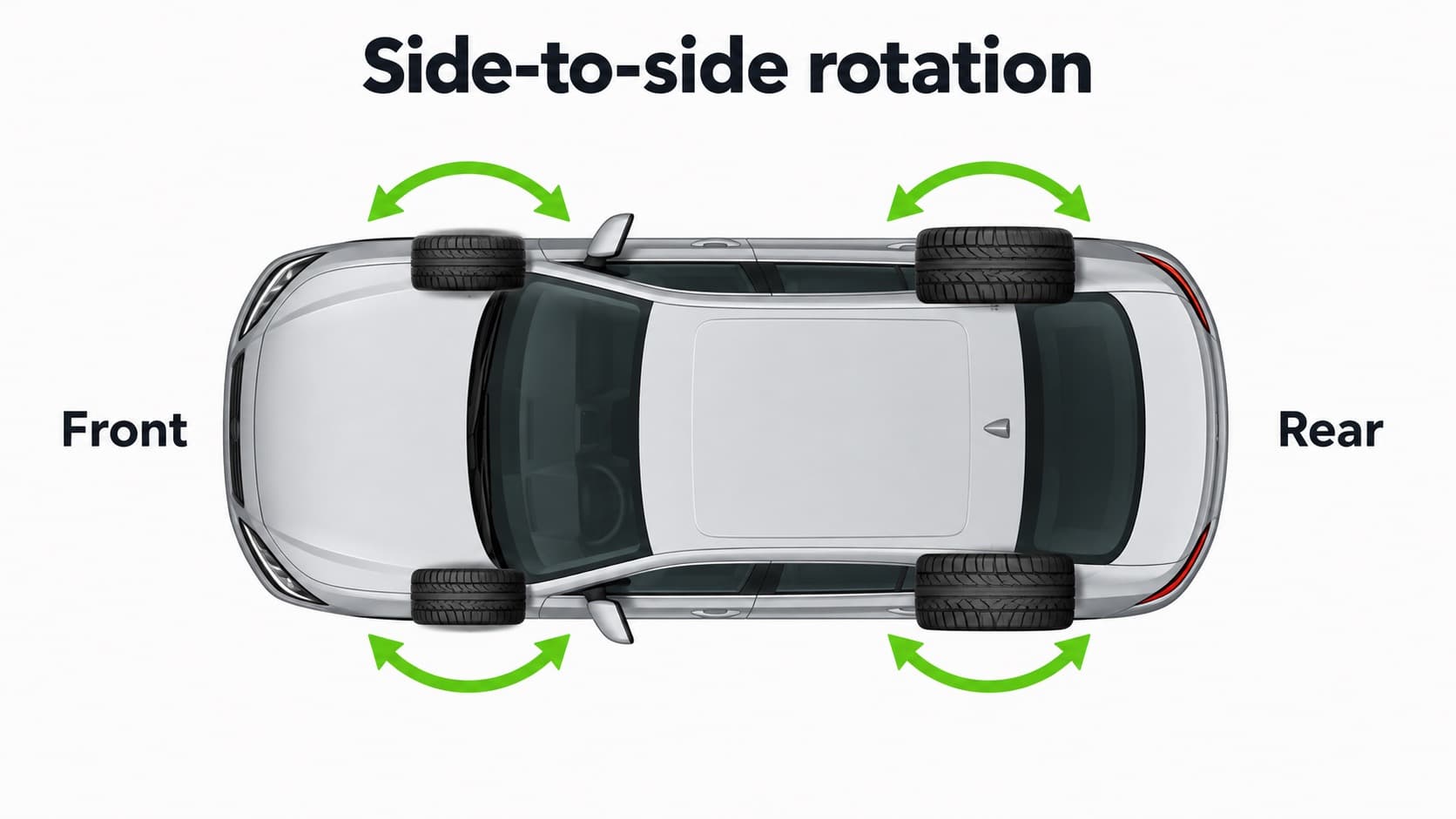
Only side to side, and only if the tires are not directional.
Most modern performance tires are asymmetric, not directional, so a side-to-side swap usually works. Look for “Outside” on the sidewall (asymmetric, can swap sides) versus a rotation arrow (directional, cannot). Side-to-side rotation evens out wear caused by road crown and cornering, but it does nothing for the front-to-rear difference. See our full guide on how often to rotate your tires.
Buying tires for a staggered setup
Staggered setups add a few steps to buying tires. Get these right and the process is simple.
- Read both sizes off the tires, front and rear. They are different, and the door jamb sticker may list both.
- Match the tire model front and rear. Mixing brands or models between axles changes the grip balance and can make the car unpredictable. Buy the same model in both sizes.
- Check that the model is available in both sizes. Use the TireDeals tire finder and search each size; a model that appears in both is a candidate.
- Match speed rating and load index to the originals on both axles.
- Confirm fitment for each axle. On the product page, the “Does this fit my vehicle?” checker confirms the size against your vehicle. Run it for the front size and the rear size separately.
- Buy in pairs when replacing. If only the rears are worn, replace both rears with the same model already on the front. If the model is discontinued, replace all four.
A note on all-wheel drive: many AWD performance cars (Audi RS, BMW xDrive M models, Mercedes-AMG 4MATIC) also come staggered. On those cars, keeping all four tires the same model and at similar tread depth matters even more, because the AWD system is sensitive to rolling diameter differences.
Find tires for your vehicle
Enter your vehicle details to see tires that fit.
Find tires for your vehicleShould you switch to staggered or square?
Switching from square to staggered makes sense if you have a rear-drive car with more power than the rear tires can handle, or you want the look. It costs a new set of rear wheels and more expensive tires over time. Keep the overall diameter within 3 percent front to rear and check for fender and suspension clearance.
Switching from staggered to square is popular with track and autocross drivers, who prefer a neutral handling balance and full rotation. It usually means running the front size at all four corners on the same wheel width, which reduces rear grip. On a very powerful car, that can make it tail-happy, so it is not a change to make casually.
Either way, a change in wheel width or offset can affect fitment. Use the fitment checker with the exact size you plan to run.
Frequently asked questions
Need tires for a staggered setup? Search by size, confirm fitment on the product page, and choose a local or mobile installer at checkout. Free shipping on every tire and a price match on every tire.