Your recommended tire pressure is on the driver’s door sticker, not the tire. Learn how to find it, check it correctly, adjust for weather, and what the TPMS light means.
Your recommended tire pressure is printed on a sticker inside the driver’s door jamb, and for most cars it falls between 30 and 36 PSI. The number on the tire sidewall is the maximum pressure, not the recommended one. Check your tires monthly when they are cold, and expect pressure to drop about 1 PSI for every 10°F the temperature falls.
Last updated: September 2026. Written by Adil Riaz, Founder & CEO of TireDeals.
This guide is part of our complete guide to buying tires online.
In this guide
- Where to find your recommended tire pressure
- Why the sidewall number is wrong
- How to check tire pressure correctly
- How temperature changes tire pressure
- What underinflation and overinflation do
- What the tire pressure light means
- Frequently asked questions
Where to find your recommended tire pressure
Look in these places, in order:
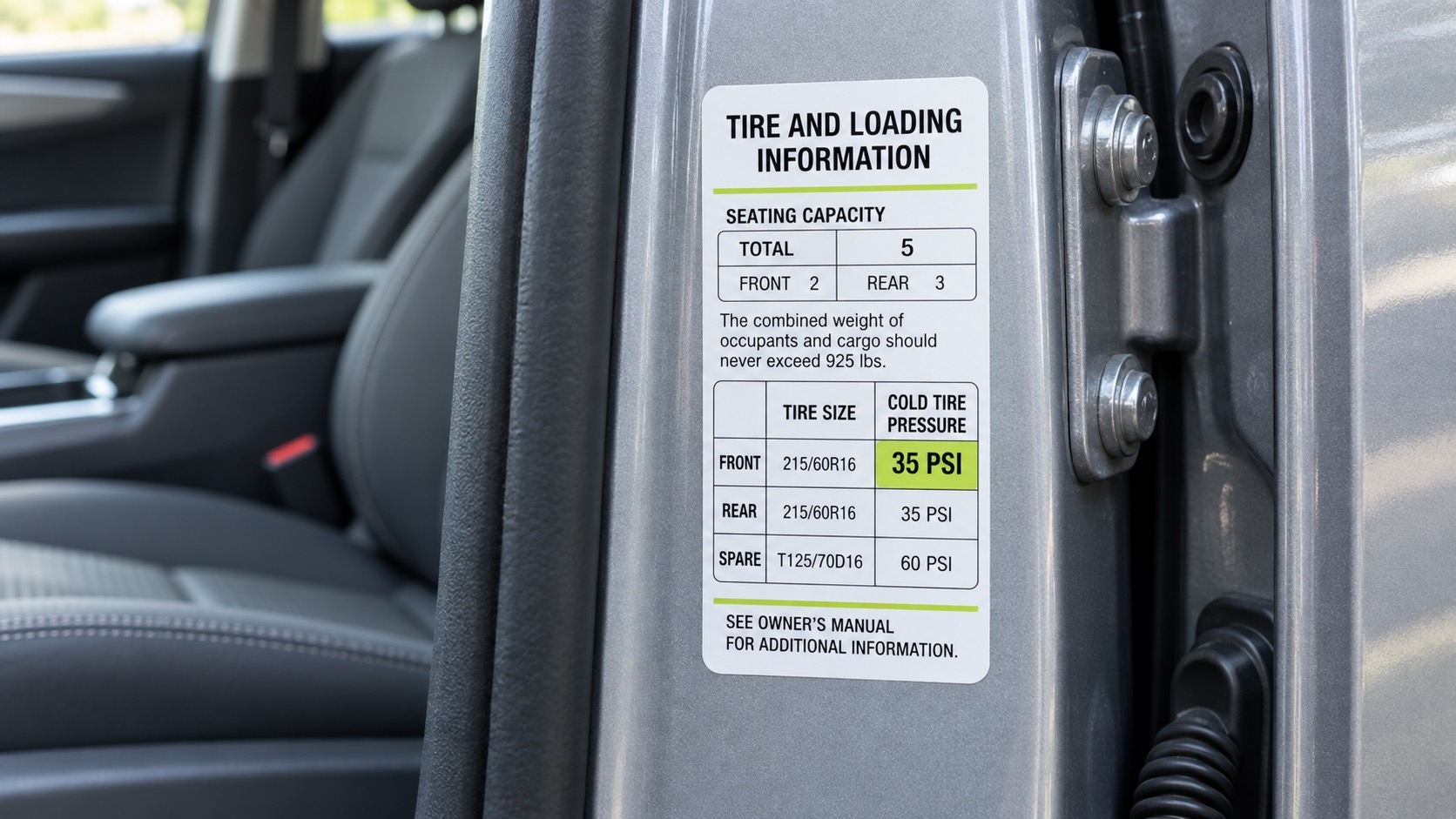
- The driver’s door jamb sticker. Open the driver’s door and look at the frame where the door latches. The tire and loading information label lists the original tire size and the cold inflation pressure for front and rear tires. This is the number to use.
- The owner’s manual. Same information, usually in the specifications or tire section.
- The fuel door or glove box lid on some vehicles.
The pressure is set by the vehicle manufacturer, not the tire maker, because it depends on the vehicle’s weight, suspension, and handling design. Two cars with the same tire size can have different recommended pressures.
Front and rear pressures sometimes differ, especially on rear-wheel-drive cars and on trucks that carry loads. Some vehicles also list a higher pressure for full passenger loads or towing.
Typical ranges, for orientation only. Your door sticker is the real number.
| Vehicle type | Typical recommended pressure |
|---|---|
| Compact and mid-size cars | 30–35 PSI |
| Crossovers and SUVs | 32–38 PSI |
| Half-ton pickups | 35–40 PSI (rear may be higher when loaded) |
| Heavy-duty trucks on LT tires | 50–80 PSI, often different front and rear |
| Compact spare | 60 PSI |
Why the sidewall number is wrong
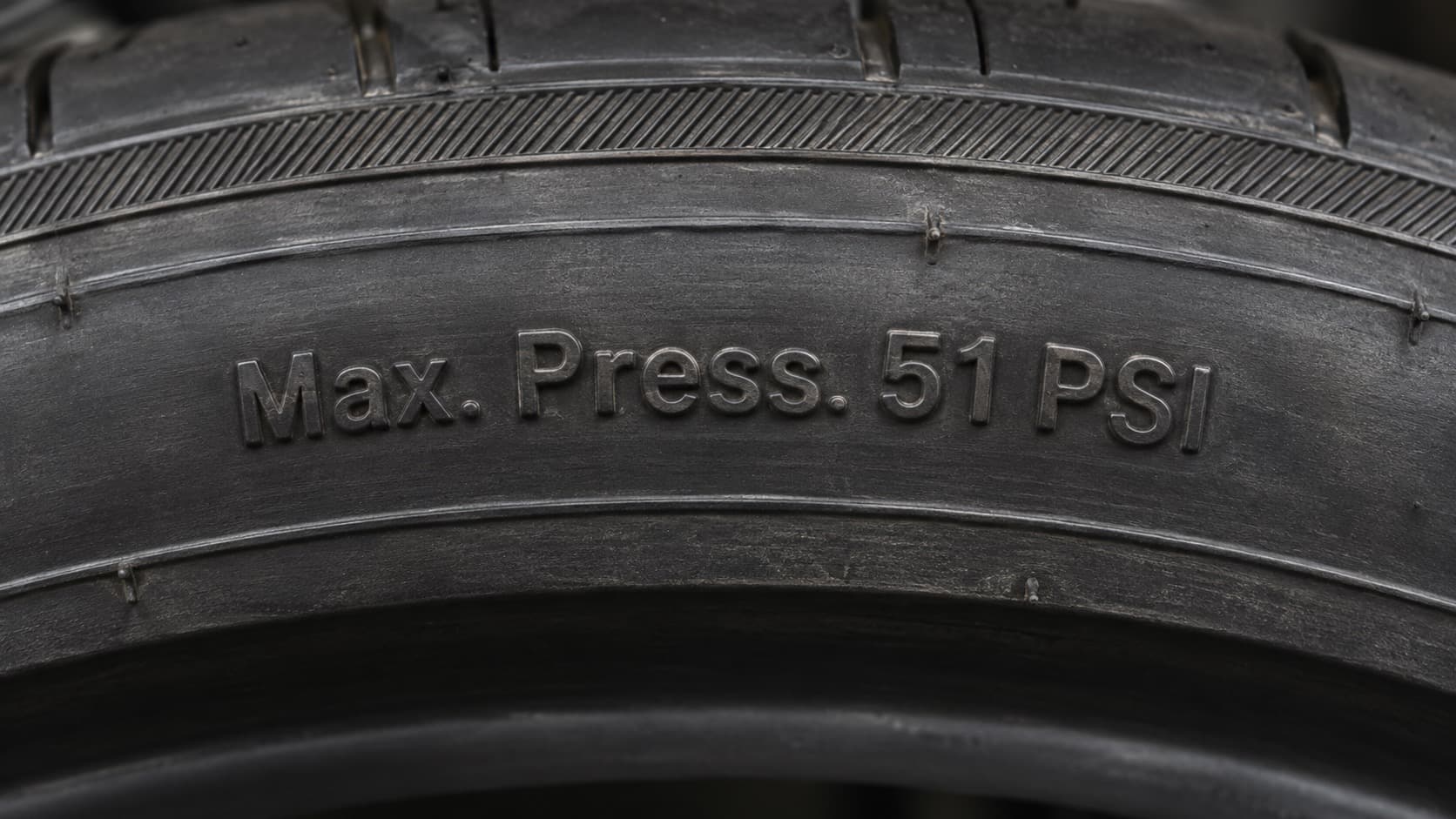
The sidewall shows a line such as “Max. Press. 51 PSI.” That is the maximum the tire can safely hold, not the pressure your car needs. Inflating to the sidewall maximum makes the ride harsh, shrinks the contact patch, and wears out the center of the tread.
If you replaced your tires with a different size than the door sticker lists, the recommended pressure may change. Ask your installer or check with the tire manufacturer, and use our tire size guide to compare the old and new sizes.
Find tires for your vehicle
Enter your vehicle details to see tires that fit.
Find tires for your vehicleHow to check tire pressure correctly
You need a tire pressure gauge. A digital or dial gauge costs $10 to $20 and is more accurate than the pencil-style ones. Gas station gauges are often worn and inaccurate.
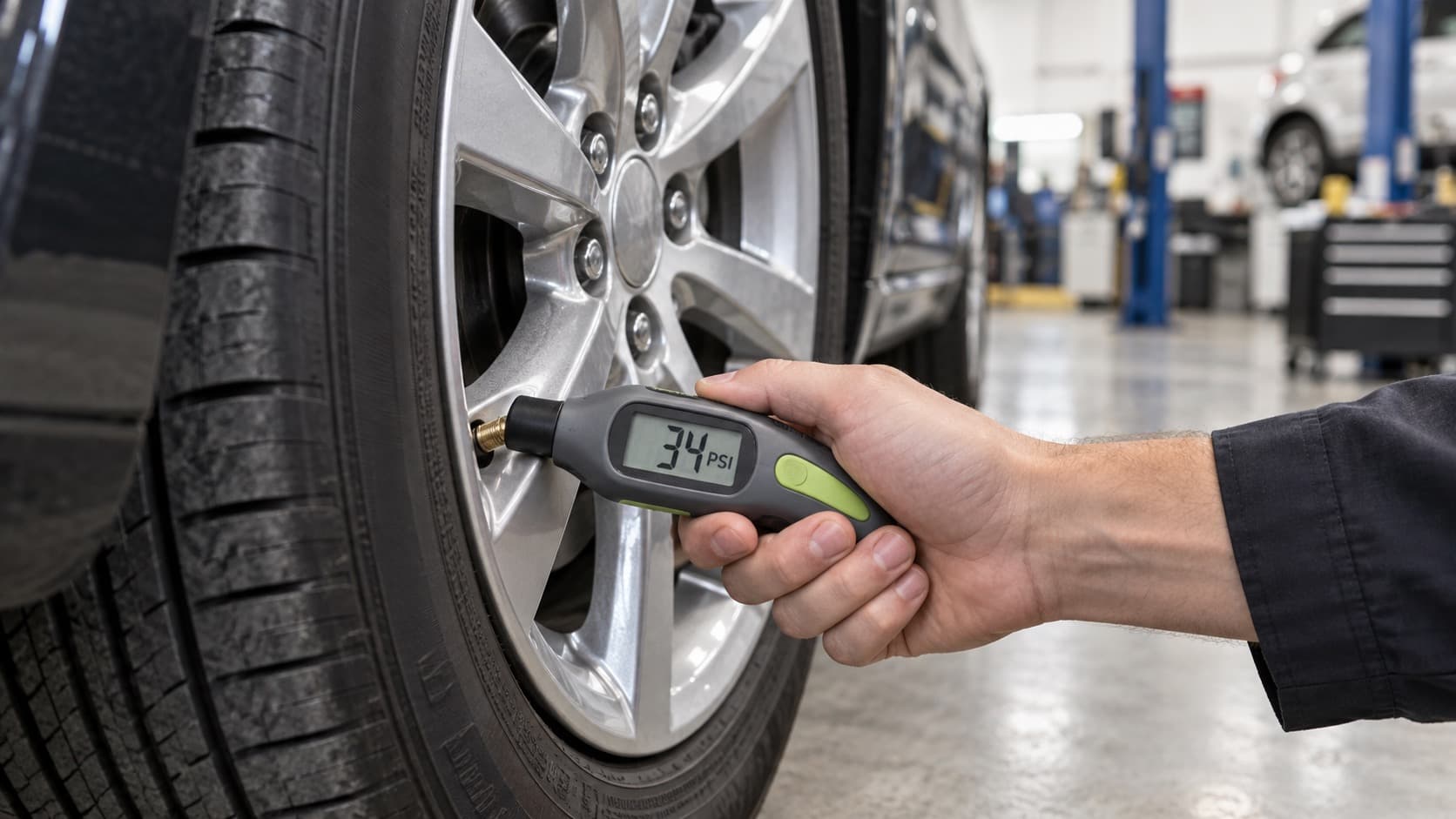
- Check when the tires are cold. That means the car has not been driven for at least three hours or has gone less than a mile. Driving heats the air inside the tire and raises the reading by several PSI.
- Unscrew the valve cap and press the gauge straight onto the valve stem until the hissing stops.
- Read the pressure and compare it to the door sticker.
- Add air at a gas station or with a portable compressor if it is low. Add in short bursts and re-check.
- Release air by pressing the pin in the valve stem if it is high, then re-check.
- Replace the valve cap. It keeps dirt and moisture out of the valve.
- Check all four tires and the spare. Spares lose air too, and a flat spare is useless.
Do this once a month and before any long trip. Tires naturally lose 1 to 2 PSI per month even with no leak.
How temperature changes tire pressure
Tire pressure drops roughly 1 PSI for every 10°F drop in air temperature, and rises the same amount as it warms. That is why the tire pressure light often comes on during the first cold morning of fall.
Set your pressure to the door sticker when the tires are cold. Do not lower the pressure after a drive to match the sticker; the tire is designed to run at the higher hot pressure. Re-check when seasons change.
| Temperature change | Pressure change |
|---|---|
| 70°F to 40°F (a cold snap) | About 3 PSI lower |
| 70°F to 20°F (winter) | About 5 PSI lower |
| 70°F to 100°F (summer heat) | About 3 PSI higher |
| Highway driving for 30 minutes | 3 to 5 PSI higher (do not bleed this off) |
What underinflation and overinflation do
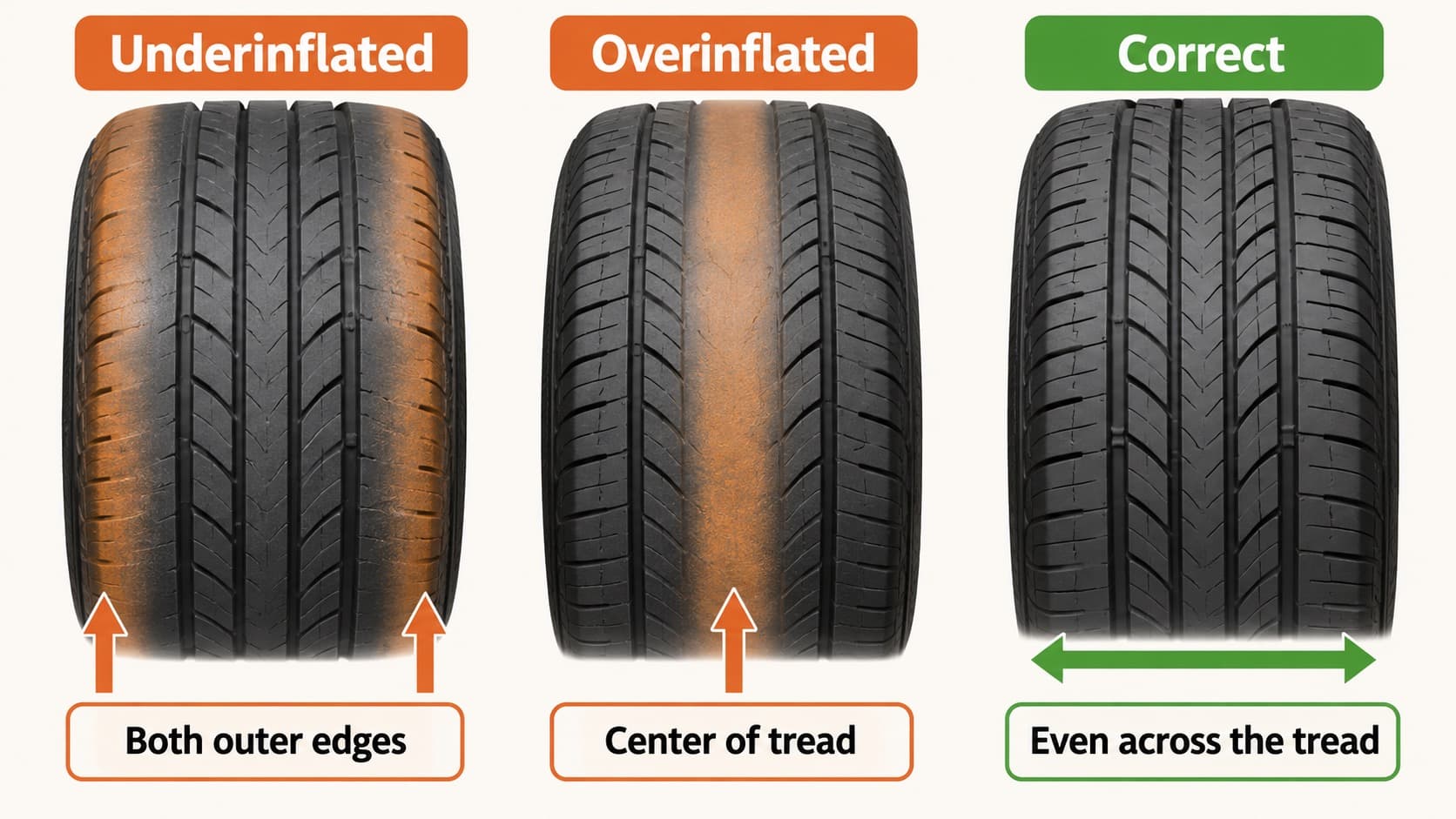
Underinflation is the more common and more dangerous problem. A tire running low flexes more, builds heat, and wears on both outer edges. Fuel economy drops about 0.2 percent for every 1 PSI below the recommended pressure across all four tires, according to the U.S. Department of Energy. Braking distances grow and the tire is more likely to fail at highway speed. NHTSA has found that roughly one in four passenger vehicles is driving on at least one significantly underinflated tire.
Overinflation makes the ride stiff, reduces the contact patch, wears the center of the tread, and makes the tire more vulnerable to pothole damage. It does not improve fuel economy enough to be worth it.
What the tire pressure light means
The tire pressure monitoring system (TPMS) light, a horseshoe shape with an exclamation point, comes on when at least one tire is about 25 percent below the recommended pressure. That is a large drop, so do not treat the light as a routine reminder. Check all four tires with a gauge as soon as you can.
- Solid light: one or more tires is low. Inflate to the door sticker pressure and the light should clear after a short drive.
- Flashing light for 60 to 90 seconds, then solid: a TPMS sensor or the system itself has a fault. The system cannot monitor pressure until it is fixed.
- Light after a cold morning: pressure dropped with the temperature. Top up the tires; it is not a leak.
- Light that keeps returning: a slow leak. Have the tire inspected for a nail or a damaged valve.
TPMS is a warning, not a substitute for a monthly check. A tire can be 5 or 6 PSI low, well into the range where it wears and wastes fuel, without triggering the light.
| Problem | Wear pattern | Other effects |
|---|---|---|
| Underinflated | Both outer edges | Heat buildup, worse fuel economy, longer braking, blowout risk |
| Overinflated | Center of tread | Harsh ride, less grip, pothole damage |
| Correct | Even across the tread | Full tread life, best handling and mileage |